

CREATE SYMBOLS, FOOTPRINTS, AND 3D MODELS FROM PRE-AUTHORED DATA

ULTRA LIBRARIAN FREE READER

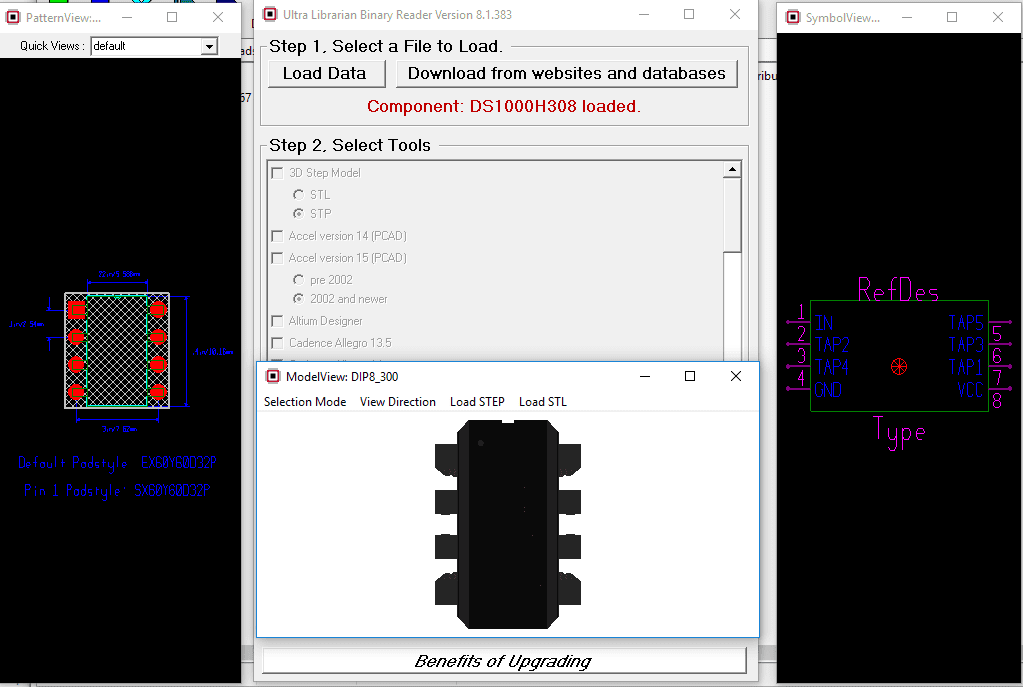
Preview models prior to downloading

Choose from over 20 different CAD export options

chrome newtab most visited
CONVERT BXL FILES INTO YOUR PREFERRED CAD FORMAT

The free reader is a lite version of Ultra Librarian specifically designed to import vendor neutral CAD data (.bxl files) from manufacturers’ websites and then export symbols, footprints, and 3D models to specific CAD tool formats. The reader is a read-only tool and will not allow users to make any changes to the data. For symbols, footprints, and 3D model creation capabilities, use one of the Ultra Librarian Desktop Software options.

BXL FILES FROM YOUR FAVORITE IC MANUFACTURERS

Many of our IC partners offer BXL files for their components directly on their websites. Once you have obtained a BXL file it is quick and easy to convert to your preferred CAD format through our online BXL conversion tool.

Check out all manufacturers here.

EXPORT TO OVER 30 DIFFERENT CAD FORMATS

VENDOR NEUTRAL FILES

Accel EDA 14 & 15

  • DesignSpark
  • Mentor Graphics
  • BoardStation
  • Mentor Graphics Design Architect
  • Mentor Graphics Design
  • Expedition 99 and 2000
  • PCAD 2000, 2001, 2002, 2004, and 2006
  • STL
  • TARGET 3001!
  • View Logic ViewDraw
  • Zuken CadStar 3 and 4
  • Zuken CR-5000 and CR-8000

FREQUENTLY ASKED QUESTIONS

A .BXL file contains electronic data created by Ultra Librarian in a universal format and is used for distributing PCB information. .BXL files can be opened by the Ultra Librarian Free Reader and translated into your choice of 22 different CAD formats.

Ultra Librarian has partnered with major IC manufacturers to create electronic data representing their parts and are available to the public. Partners include Analog Devices, Texas Instruments, Microchip, Maxim, Silicon Labs, Renesas, Exar, and NXP.

Yes, you can use our Online Reader if you don’t want to download the Free Reader

Free Reader

"*" indicates required fields

Click the button (the pencil icon) in the bottom-right corner of the New Tab page. In the side panel that opens, locate the Shortcuts section. Toggle the selection between: My shortcuts: Shortcuts are curated by you.

If your grid suddenly vanishes and leaves an empty space beneath the search bar, the issue is usually tied to your customization settings or an extension conflict.

Chrome allows you to completely toggle off the automated tracking in favor of a strictly manual setup.

In recent versions of Chrome, the new tab page has become more streamlined and visually appealing. The Most Visited section is still present, but it's now accompanied by other features, such as:

You do not have to leave your New Tab page up to the algorithm. Chrome allows you to take manual control of these tiles to turn them into static, reliable shortcuts. Adding a Custom Shortcut

A common reason shortcuts disappear entirely is an accidental setting change. Click in the bottom-right of a New Tab. Go to the Shortcuts section.

Select to delete it, or Edit shortcut to change the link. 3. Switching Between "Most Visited" and "My Shortcuts"

Replaces the standard page with a beautiful landscape photo, a personal to-do list, weather updates, and a clean layout for your favorite links.

This guide will break down everything you need to know about Chrome’s "Most Visited" feature, from how it ranks your sites to fixing common issues and customizing it for maximum efficiency.

: The amount of time spent on a site can influence its perceived importance.

Click the (or the X icon) that appears in the top-right corner of the tile.

A major advantage of the "Most Visited" feature is its commitment to privacy.

The "Most Visited" section is a core component of Chrome's new tab page (NTP). It presents a grid of thumbnails, typically up to nine, that link to your most frequently accessed websites. Think of it as a smart, self-updating bookmark list. The goal is to act as a jumping-off point, reducing the cognitive load and time needed to start your browsing session.

Master Your Browser: A Deep Dive into Chrome’s “Most Visited” New Tab Feature

the pcb design, assembly, and trends blog

RELATED CONTENT

Chrome Newtab Most Visited =link=

Click the button (the pencil icon) in the bottom-right corner of the New Tab page. In the side panel that opens, locate the Shortcuts section. Toggle the selection between: My shortcuts: Shortcuts are curated by you.

If your grid suddenly vanishes and leaves an empty space beneath the search bar, the issue is usually tied to your customization settings or an extension conflict.

Chrome allows you to completely toggle off the automated tracking in favor of a strictly manual setup.

In recent versions of Chrome, the new tab page has become more streamlined and visually appealing. The Most Visited section is still present, but it's now accompanied by other features, such as: chrome newtab most visited

You do not have to leave your New Tab page up to the algorithm. Chrome allows you to take manual control of these tiles to turn them into static, reliable shortcuts. Adding a Custom Shortcut

A common reason shortcuts disappear entirely is an accidental setting change. Click in the bottom-right of a New Tab. Go to the Shortcuts section.

Select to delete it, or Edit shortcut to change the link. 3. Switching Between "Most Visited" and "My Shortcuts" Click the button (the pencil icon) in the

Replaces the standard page with a beautiful landscape photo, a personal to-do list, weather updates, and a clean layout for your favorite links.

This guide will break down everything you need to know about Chrome’s "Most Visited" feature, from how it ranks your sites to fixing common issues and customizing it for maximum efficiency.

: The amount of time spent on a site can influence its perceived importance. If your grid suddenly vanishes and leaves an

Click the (or the X icon) that appears in the top-right corner of the tile.

A major advantage of the "Most Visited" feature is its commitment to privacy.

The "Most Visited" section is a core component of Chrome's new tab page (NTP). It presents a grid of thumbnails, typically up to nine, that link to your most frequently accessed websites. Think of it as a smart, self-updating bookmark list. The goal is to act as a jumping-off point, reducing the cognitive load and time needed to start your browsing session.

Master Your Browser: A Deep Dive into Chrome’s “Most Visited” New Tab Feature